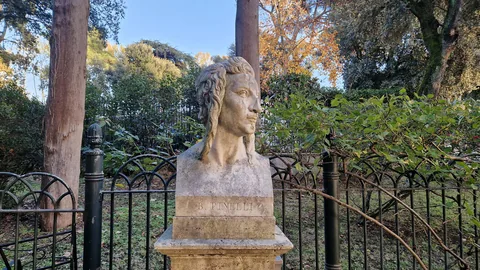
Pincio gardens · Nearby
Bartolomeo Pinelli
Pinelli’s prints and drawings made the people, gestures, and street life of Rome a subject for collectors and travelers.
Find on the mapRead aloud with your device’s voice.
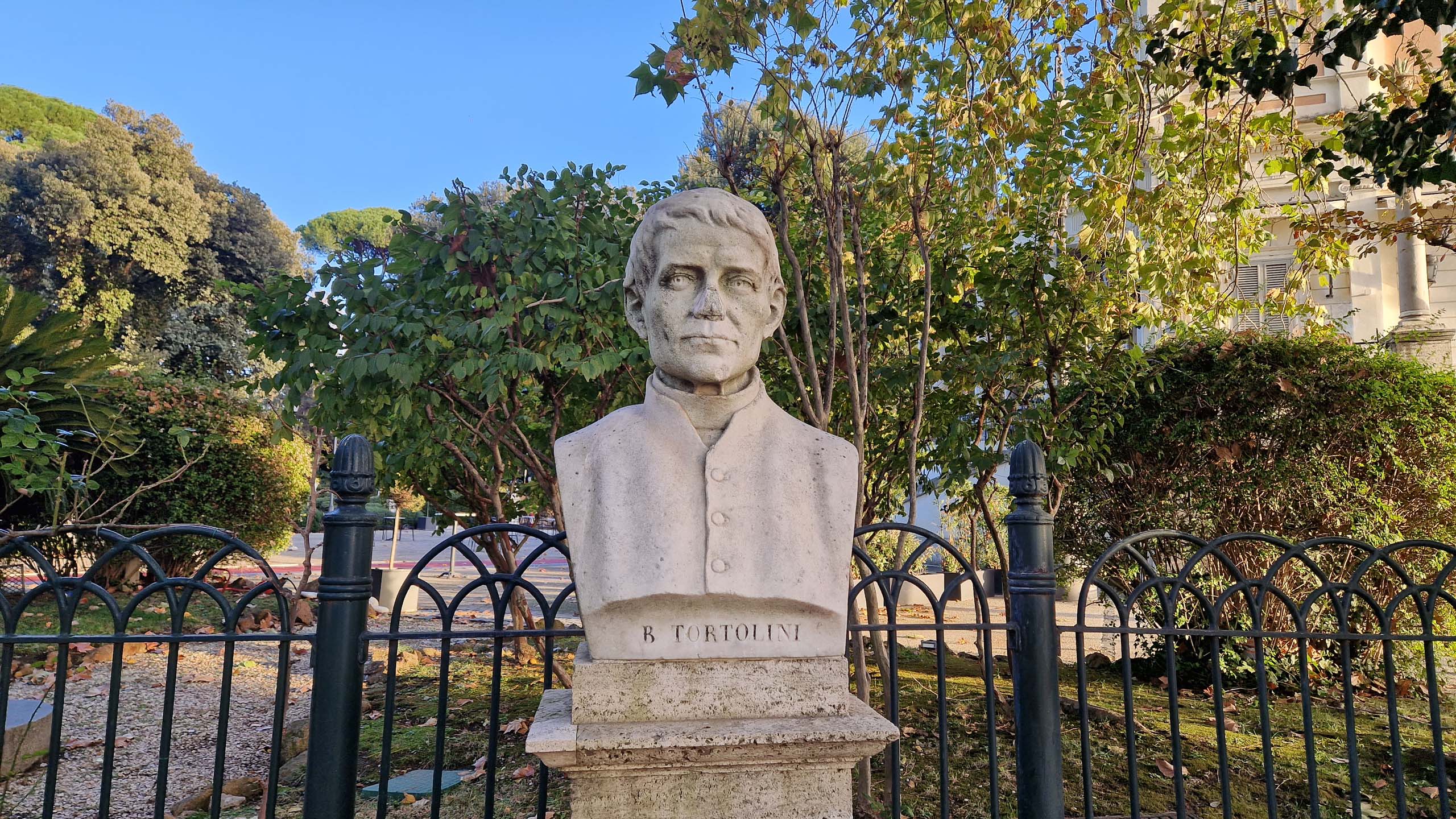
Barnaba Tortolini helped mathematics travel through print. Born in Rome in 1808, he studied at the Collegio Romano and the Sapienza, became a priest, and taught mathematical subjects. His own research included applications of integral calculus to geometry.
In 1850 he founded the Annali di scienze matematiche e fisiche. The journal gave Italian scholars a place to publish alongside contributors from other countries, including Cauchy, Cayley, and Sylvester. At a time when Italy remained politically divided, such exchanges helped form a scientific community across state borders.
The original series ran through 1857 and led into the development of the Annali di matematica. Editing involved correspondence, selection, and the practical work of sustaining publication. Those activities could be as consequential for a field as an individual theorem.
Tortolini died in 1874. His Roman career also complicates a simple opposition between religion and nineteenth-century science: clerical institutions, university teaching, and international mathematical communication overlapped in his working life.
Pincio gardens · Nearby
Pinelli’s prints and drawings made the people, gestures, and street life of Rome a subject for collectors and travelers.
Find on the mapPincio gardens · Nearby
Pallavicino moved from anti-Austrian conspiracy to a campaign for Italian unity under the Savoy monarchy.
Find on the mapPincio gardens · Nearby
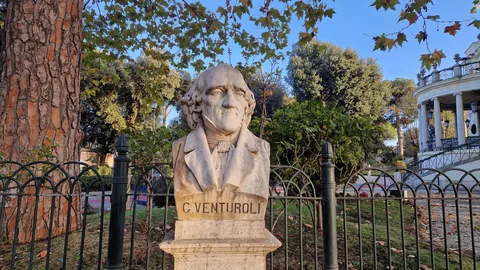
Venturoli applied mathematics to hydraulics and helped train engineers for public works in the Papal States.
Find on the mapPincio gardens · Nearby
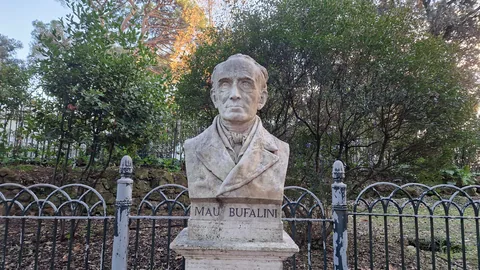
Bufalini challenged speculative medical systems and made close observation central to his teaching of pathology.
Find on the map