Pincio gardens · Nearby
Francesco Mario Pagano
Pagano brought Enlightenment arguments about criminal justice into the short-lived Neapolitan Republic of 1799.
Find on the mapVoice changes restart the current paragraph.
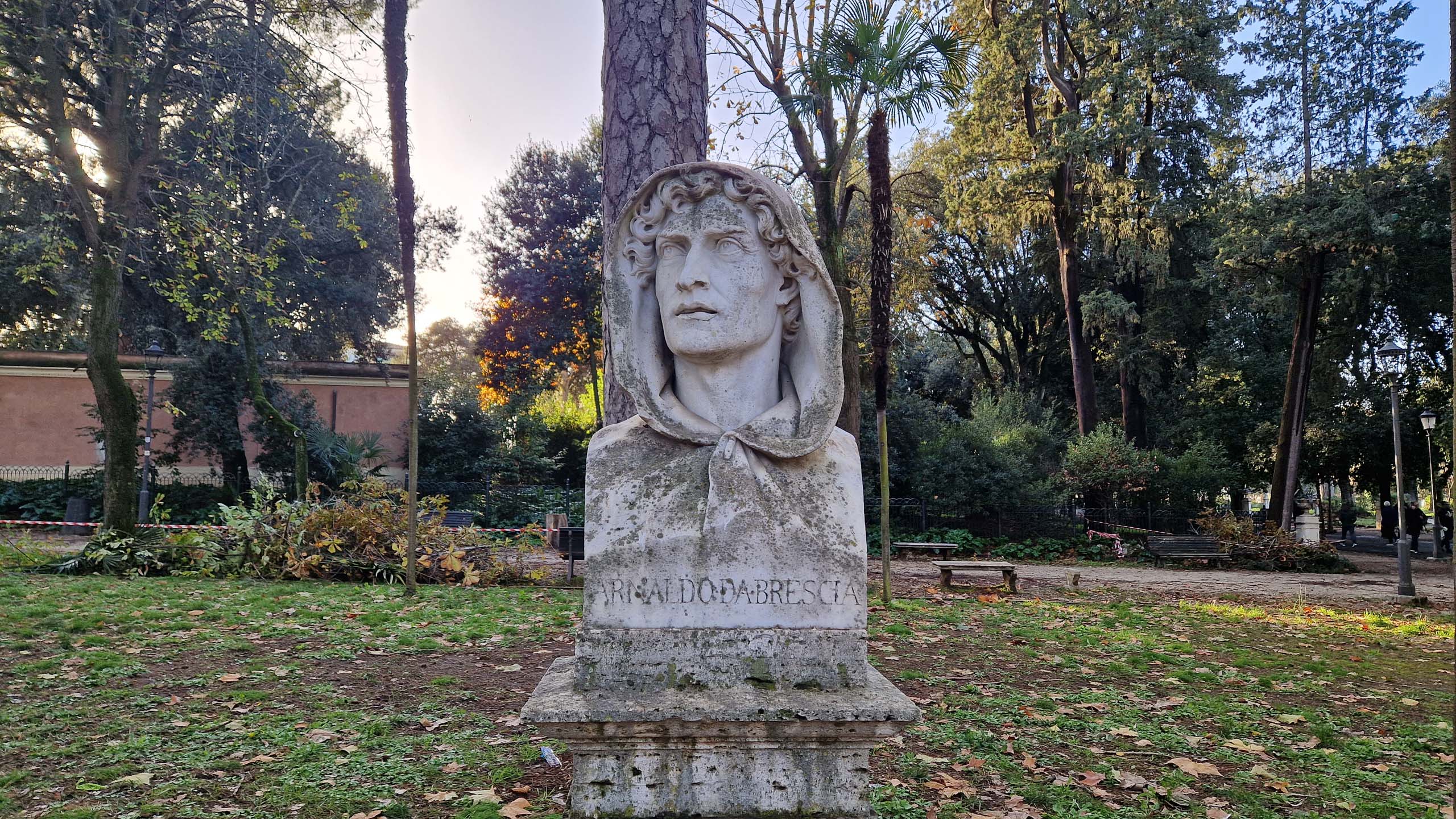
Arnold of Brescia challenged the Church’s wealth and political power. A religious reformer associated with Peter Abelard, he criticized clerical possession of property and the entanglement of spiritual authority with worldly government. His own writings have not survived in a form that allows a complete reconstruction of his thought.
In the 1140s, he became involved in the Roman commune, a movement that sought civic authority independent of papal rule. Its revival of the language of the Senate drew on ancient Roman precedent. The political society it represented was medieval, however, with its own competing families and institutions.
Arnold was captured as Frederick Barbarossa approached Rome and was executed in 1155 under Pope Adrian IV. The circumstances of his defeat made him a powerful figure for later opponents of papal temporal rule.
His presence among the Pincio portraits also belongs to that later history of remembrance. Nineteenth-century admirers could see a precursor of their own struggle in him. The comparison is revealing, provided a twelfth-century religious reformer is not turned into a modern secular nationalist.
Pincio gardens · Nearby
Pagano brought Enlightenment arguments about criminal justice into the short-lived Neapolitan Republic of 1799.
Find on the mapPincio gardens · Nearby
Guido helped singers learn unfamiliar chant through written pitch and a system of memorable syllables.
Find on the mapPincio gardens · Nearby
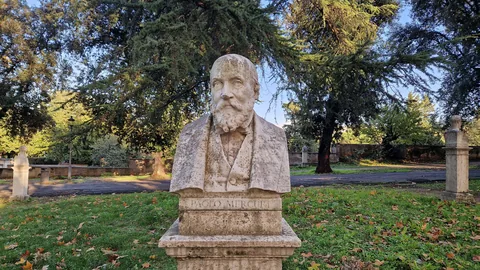
Mercuri translated paintings into engraved lines and directed Rome’s Calcografia, where prints were made, preserved, and taught.
Find on the mapPincio gardens · Nearby
A physician and philosopher, De Meis treated the history of medicine as part of a larger argument about science and society.
Find on the map