Pincio gardens · Nearby
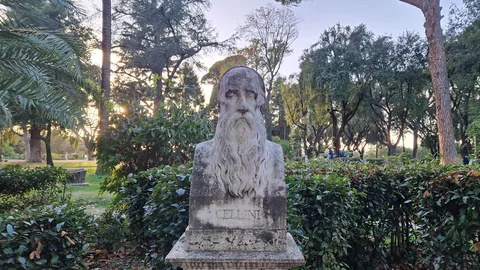
Benvenuto Cellini
Cellini made goldsmithing and sculpture serve princely display, then cast his own turbulent career as the subject of an autobiography.
Find on the mapRead aloud with your device’s voice.
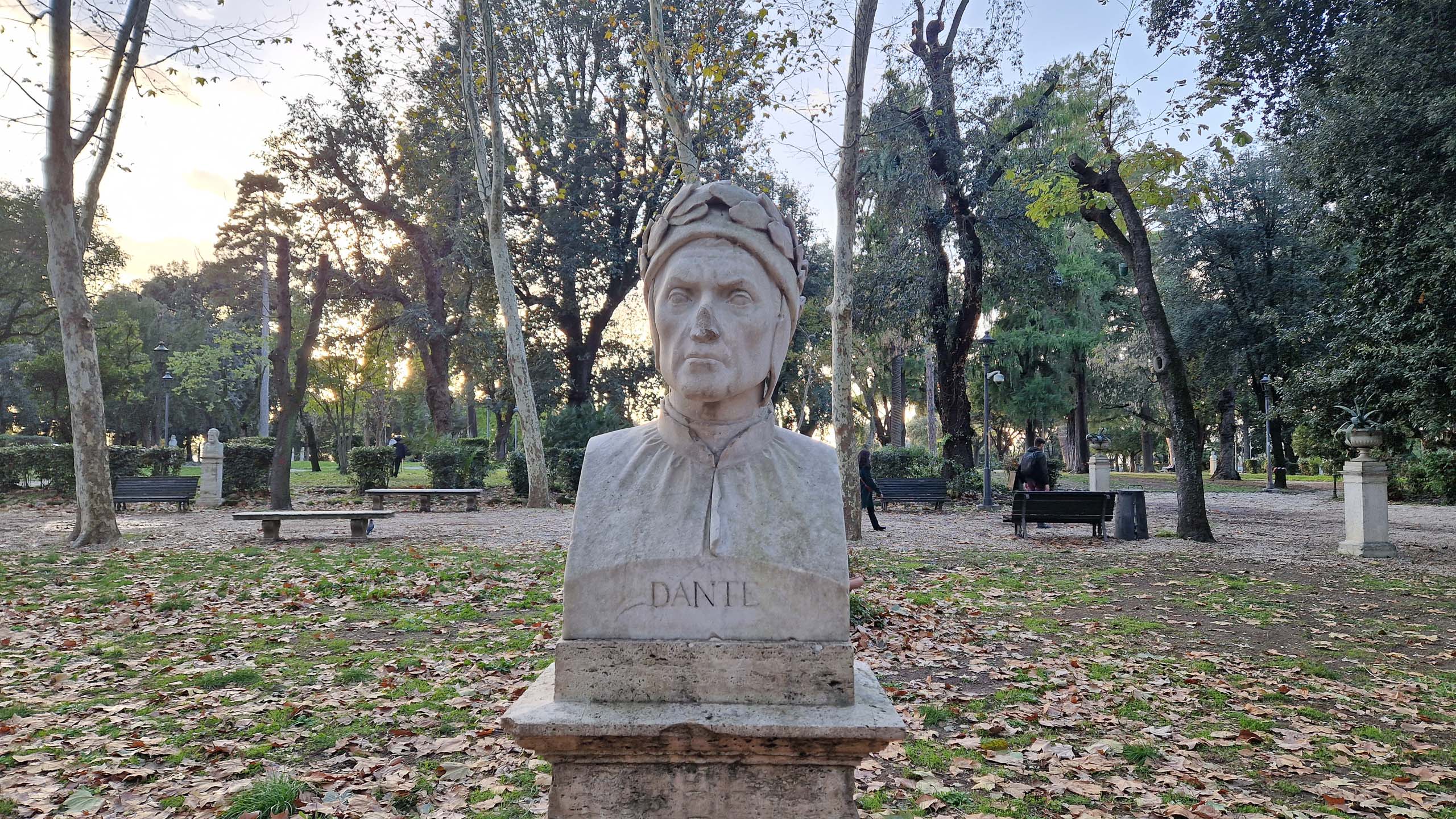
Dante Alighieri wrote about belonging after losing his own city. Exiled from Florence in 1302, he spent the rest of his life elsewhere and died in Ravenna in 1321. The political anger in his poetry belongs to that experience. In the Divine Comedy, questions of justice are asked through encounters with people who have names, histories, and unfinished arguments.
The poem follows a version of Dante through Hell, Purgatory, and Paradise. Virgil guides him through the first part of the journey; Beatrice later takes that role, and Bernard of Clairvaux accompanies its final movement. Each guide brings a different kind of authority. The poem’s changing guides help organize its passage from human learning toward theological understanding.
Its language also carries an argument. Dante used the vernacular for the Comedy, but he did not invent Italian poetry or rescue it from a world in which everyone wrote only Latin. In De vulgari eloquentia, a treatise written in Latin, he discussed poets from Sicily and several other Italian regions. His achievement rests in what he made the vernacular do: it could sustain intimate conversation, political accusation, philosophical argument, and a vision of the cosmos.
There is an awkward Roman connection worth remembering beside his bust. In that same treatise, Dante dismissed contemporary Roman speech in strikingly hostile terms. The city that later commemorated him would not have found his linguistic judgment flattering. His relationship with Rome involved an idea of imperial and religious authority, rather than unqualified affection for the people who lived there. The honor paid by a later monument and the opinions of its subject belong to different historical moments.
Pincio gardens · Nearby
Cellini made goldsmithing and sculpture serve princely display, then cast his own turbulent career as the subject of an autobiography.
Find on the mapPincio gardens · Nearby
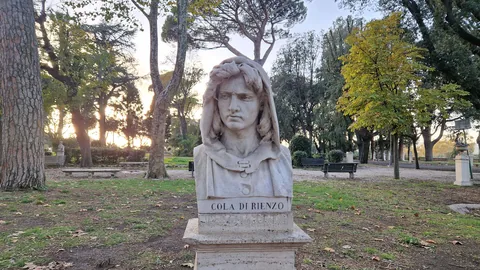
A Roman notary who became tribune in 1347, Cola di Rienzo used the language of ancient Rome to challenge the city’s barons.
Find on the mapPincio gardens · Nearby
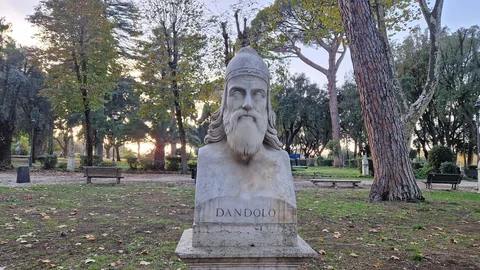
Venice’s doge during the Fourth Crusade, Dandolo helped direct the expedition that captured and sacked Constantinople in 1204.
Find on the mapPincio gardens · Nearby
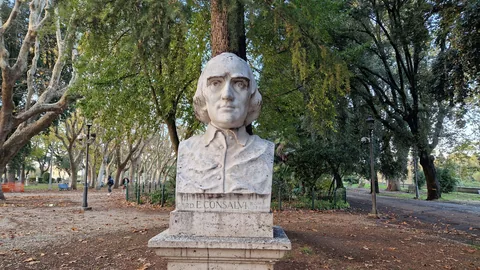
As Pius VII’s secretary of state, Consalvi negotiated with Napoleon and worked to restore the Papal States after the empire’s fall.
Find on the map